
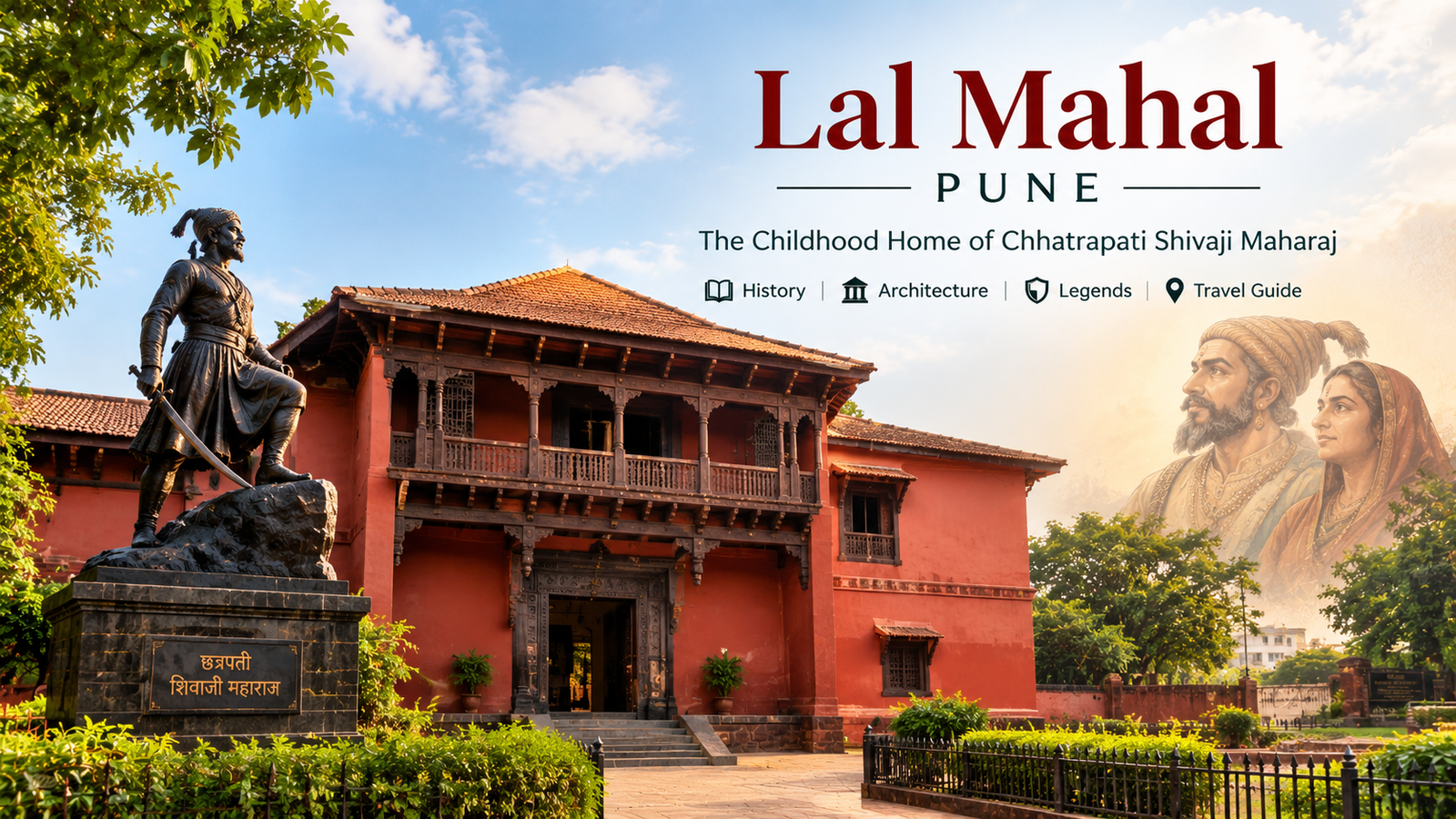
Introduction: Discover the Historic Lal Mahal of Pune
Pune is a city where history lives alongside modern life. Known for its educational institutions, bustling markets, cultural celebrations and thriving IT industry, Pune also holds an extraordinary place in the history of Maharashtra. Among its most significant historical landmarks is Lal Mahal, Pune, a monument closely associated with the childhood of Chhatrapati Shivaji Maharaj and the early history of the Maratha kingdom.
Located in the historic heart of Pune, Lal Mahal is remembered as the residence where young Shivaji Maharaj spent important years of his formative life with his mother, Rajmata Jijabai. It is also associated with one of the most celebrated military episodes in Maratha history: the daring night raid against Mughal general Shaista Khan in 1663.
The name Lal Mahal literally translates to Red Palace. Although the original palace no longer survives in its historical form, the reconstructed memorial allows visitors to connect with the stories of Shivaji Maharaj, Jijabai and the emergence of Maratha power.
Today, Lal Mahal is more than a tourist attraction. It represents courage, leadership, self-respect, determination and the historical identity of Maharashtra. Whether you are a history enthusiast, a student, a traveller or a Pune resident interested in the city’s heritage, Lal Mahal offers an opportunity to explore a remarkable chapter of India’s past.
In this guide, we will explore the history of Lal Mahal, its connection with Shivaji Maharaj and Jijabai, the famous Shaista Khan incident, its architecture, historical importance and practical information for visitors.
1. What Is Lal Mahal?
Lal Mahal is a historic memorial in Pune, Maharashtra, associated with Chhatrapati Shivaji Maharaj and his mother, Jijabai. The original palace was established by Shahaji Raje Bhosale for his family during the seventeenth century.
The palace became an important residence during Shivaji Maharaj’s childhood and youth. It was situated in the old part of Pune, close to the settlement that developed around Kasba Peth and the Kasba Ganpati area.
The location is particularly significant because Pune was not yet the large urban centre that it is today. Much of the surrounding region consisted of settlements, agricultural land and strategically important routes. Establishing a family residence in Pune was connected with the broader political and administrative circumstances of the Deccan during that period.
Lal Mahal is also remembered for the events of 1663, when Shivaji Maharaj launched a surprise attack against Shaista Khan, a Mughal commander who had occupied Pune and made the palace his headquarters.
The building visitors see today is a reconstruction rather than the untouched original palace. The Pune Municipal Corporation reconstructed the memorial during the 1980s, and it serves as a place where visitors can learn about Shivaji Maharaj’s life and the history associated with the site.
This distinction is important: the present Lal Mahal preserves the memory of the historic palace, but it should not be mistaken for the complete original seventeenth-century structure.
2. The History of Lal Mahal
To understand Lal Mahal, it is necessary to look at the political situation of the Deccan during the early seventeenth century.
The region was shaped by competing powers, including the Deccan Sultanates and the expanding Mughal Empire. Military campaigns, changing alliances and disputes over territory influenced the lives of local rulers and communities.
Shahaji Raje Bhosale, a prominent military leader and father of Shivaji Maharaj, was involved in the political affairs of the Deccan. During this period, he arranged for a residence in Pune for his wife Jijabai and their son.
Historical accounts commonly associate the establishment of Lal Mahal with 1630. Other accounts place the family’s arrival at the palace around 1642, when Shivaji Maharaj was approximately twelve years old. These dates refer to different stages in the palace’s history and should not be treated as identical events.
The palace became an important centre of family life and the upbringing of young Shivaji.
Why was Lal Mahal built?
The establishment of Lal Mahal was connected with the need for a suitable residence for Jijabai and Shivaji Maharaj in Pune. It also reflected the importance of developing and maintaining a base in the region.
Pune’s later rise as a major political centre was not inevitable at the time. The city developed through several historical phases, and the presence of influential families, administrative activity and regional power struggles helped shape its growth.
The palace was therefore significant not only as a residence but also as part of the history of Pune’s development.
The name Lal Mahal is traditionally associated with the red bricks used in the original building. Over time, the name became inseparable from the childhood of Shivaji Maharaj and the stories of the Maratha struggle.
Lal Mahal and the early years of Shivaji Maharaj
Shivaji Maharaj spent important years of his early life at Lal Mahal. During this period, he was exposed to the political realities of the Deccan and the challenges facing the region’s people.
His later achievements included the establishment of an independent Maratha kingdom, the capture of strategically important forts and the development of military and administrative systems that strengthened Maratha power.
It is important to understand that these achievements were not the result of a single place or moment. They developed over time through leadership, military experience, political decisions, alliances and the efforts of many people.
Nevertheless, Lal Mahal remains one of the most recognisable places associated with Shivaji Maharaj’s formative years.
3. Rajmata Jijabai: The Mother Who Helped Shape a Leader
No account of Lal Mahal is complete without discussing Rajmata Jijabai, one of the most respected women in Maharashtra’s historical memory.
Jijabai was the mother of Shivaji Maharaj and a central figure in the stories surrounding his upbringing. She is remembered for her determination, religious and cultural influence, commitment to her son’s future and role in the household during a period of political uncertainty.
Jijabai’s influence on Shivaji Maharaj
Historical traditions associate Jijabai with the values of courage, justice, responsibility and concern for the welfare of ordinary people. Stories about Shivaji Maharaj’s childhood frequently highlight the lessons he received from his mother and the ideals she encouraged.
These accounts have become an important part of Maharashtra’s cultural memory. While individual stories may differ in their historical details, Jijabai’s significance as a mother, mentor and influential figure remains widely recognised.
Raising a child during a period of military conflict and political instability was not an easy responsibility. Jijabai’s life was shaped by uncertainty, family separation and the shifting fortunes of the Deccan’s ruling powers.
Her presence at Lal Mahal connects the monument with the domestic and human side of history. Beyond armies, battles and political decisions, the palace represents a family environment in which a future ruler grew up.
Jijabai and the development of Pune
Jijabai is also remembered in connection with the development of Pune during Shivaji Maharaj’s early years.
The traditional account of Shivaji Maharaj ploughing land with a golden plough, in the presence of Jijabai and associated figures, symbolises the renewal of agricultural life and the restoration of prosperity. The story is often represented in popular depictions of Shivaji Maharaj.
Such stories are meaningful because they connect leadership with the well-being of the community. Agriculture, security and the stability of settlements were essential concerns in a region frequently affected by military conflict.
Visitors to Lal Mahal may encounter artistic representations of Shivaji Maharaj and Jijabai that celebrate this aspect of their historical legacy.
Why Jijabai’s story matters today
Jijabai’s legacy continues to inspire discussions about parenting, education, leadership and women’s contributions to history.
Her story also reminds visitors that historical achievements rarely emerge in isolation. Family members, teachers, advisers, soldiers and communities can all influence the development of a leader.
Lal Mahal offers a way to remember Jijabai not simply as the mother of a famous ruler but as a significant figure in her own right.
4. Shivaji Maharaj’s Childhood and the Foundations of Swarajya
Lal Mahal is closely linked with the early life of Chhatrapati Shivaji Maharaj and the development of the ideals that later became associated with Swarajya.
The word Swarajya is generally understood as self-rule. In the context of Shivaji Maharaj’s life, it refers to the establishment and expansion of an independent political authority rather than continued dependence on larger regional powers.
During his youth, Shivaji Maharaj became familiar with the geography, settlements and hill forts of the Deccan. The region’s landscape played a major role in the military strategies later associated with the Marathas.
From Pune to the hill forts
The hill forts around Pune and the wider Sahyadri mountain range were important strategic locations. Their elevated positions, difficult approaches and connections with surrounding routes made them valuable for defence and regional control.
Shivaji Maharaj’s early military campaigns included the capture of Torna Fort in 1645, an event widely regarded as a major milestone in his rise.
As his activities expanded, the focus of his military and political operations shifted beyond Lal Mahal. The palace remained a symbol of his early life, while forts and other centres became increasingly important to the developing Maratha state.
Leadership, planning and strategy
Shivaji Maharaj is remembered for his use of terrain, intelligence, mobility and surprise in military operations. These methods were particularly suited to the mountainous landscape of the Deccan.
His later successes were supported by a combination of military organisation, political negotiation, local knowledge and the efforts of commanders and soldiers.
Lal Mahal is an appropriate starting point for understanding this larger story. It connects the visitor with the early years before Shivaji Maharaj became one of the most influential rulers in Indian history.
5. The Famous Shaista Khan Encounter at Lal Mahal
One of the most widely remembered episodes associated with Lal Mahal is the surprise attack on Mughal general Shaista Khan in 1663.
This event gave the palace a lasting place in accounts of the conflict between Shivaji Maharaj and the Mughal Empire.
Who was Shaista Khan?
Shaista Khan was a senior Mughal noble and military commander. He was sent to the Deccan during Emperor Aurangzeb’s reign to challenge Shivaji Maharaj and weaken the growing Maratha power.
Mughal forces entered Pune and occupied important locations. Shaista Khan used Lal Mahal as his headquarters, a particularly provocative development because the palace was associated with Shivaji Maharaj’s childhood.
The occupation demonstrated the extent of Mughal military pressure in the region. It also created a situation in which Shivaji Maharaj had strong strategic and symbolic reasons to challenge the Mughal presence.
The daring night raid of 1663
In April 1663, Shivaji Maharaj led a surprise attack against Shaista Khan’s camp in Pune.
Popular historical accounts describe Shivaji Maharaj and his men entering the city at night, with versions of the story associating their entry with a wedding procession or the use of disguises to avoid suspicion.
The exact details of the operation are presented differently in different retellings. However, the central event—the surprise assault on Shaista Khan’s residence—is a well-known episode in Maratha history.
The attackers reached the occupied palace and a violent confrontation followed. Shaista Khan’s son and other members of his entourage were killed during the raid, according to historical accounts. Shaista Khan himself escaped but reportedly lost several fingers while trying to flee.
The attack was significant because it struck at a senior Mughal commander’s headquarters in a location where the Mughal forces should have had considerable control.
Why was the attack important?
The raid was not simply a personal confrontation between two leaders. It carried important military and political consequences.
First, it demonstrated that a larger occupying force could still be vulnerable to a carefully planned surprise attack. Second, it challenged the image of Mughal military dominance in Pune. Third, it strengthened Shivaji Maharaj’s reputation for bold planning and tactical execution.
The event also had a powerful symbolic meaning because Shaista Khan had occupied Lal Mahal, the place associated with Shivaji Maharaj’s childhood.
For Shivaji Maharaj and his followers, the attack demonstrated their ability to strike back despite facing a much larger imperial power.
What happened to Shaista Khan afterward?
The raid embarrassed the Mughal administration. Shaista Khan subsequently left Pune, and Mughal policy in the Deccan continued to evolve as the conflict with Shivaji Maharaj developed.
The episode became one of the best-known stories of Shivaji Maharaj’s military career and remains a major reason visitors associate Lal Mahal with courage, surprise and strategic planning.
When visiting the monument, it is worth remembering that the present building is a reconstructed memorial. The importance of the site lies in its connection to the historical event, not in the survival of every room or wall where the encounter occurred.
6. What Happened to the Original Lal Mahal?
A common question among visitors is whether the Lal Mahal seen today is the original palace.
The answer is no. The original seventeenth-century structure did not survive intact.
After the events associated with Shivaji Maharaj, Pune continued to experience political changes. The city later became an important centre under the Peshwas, and the original palace deteriorated over time.
Historical accounts indicate that the building suffered damage and eventually became associated with storage uses, including the term Ambarkhana. By the nineteenth century, descriptions of the site referred to substantial ruins and surviving portions of the old structure.
Over the years, the original palace’s physical form was lost. This means that modern visitors cannot walk through the complete building in which Shivaji Maharaj grew up.
Reconstruction of Lal Mahal
The Pune Municipal Corporation reconstructed Lal Mahal during the 1980s as a memorial to Shivaji Maharaj and Jijabai. The work is commonly dated to the period between 1984 and 1988.
The reconstructed building was intended to preserve the memory of the historic palace and provide a public place where people could learn about Shivaji Maharaj’s life.
It is therefore more accurate to describe the present Lal Mahal as a reconstructed memorial on the historic site rather than a fully preserved original palace.
This distinction does not diminish its historical importance. Many monuments and memorials preserve the memory of structures that have been damaged, altered or lost over time.
In the case of Lal Mahal, the connection to Shivaji Maharaj and Jijabai is central to its continuing cultural significance.
7. Architecture of Lal Mahal
The present Lal Mahal is a reconstruction designed to evoke the memory of the historic palace. Its red appearance is one of its most recognisable visual features.
Visitors often notice the red walls, the entrance, the palace-like appearance and the decorative elements associated with the memorial.
However, because the original building has not survived intact, the current structure should not be treated as a complete architectural record of the seventeenth-century palace.
The red exterior
The red colour is closely associated with the identity of Lal Mahal. The name itself translates to Red Palace, and the colour helps distinguish the memorial from many other historic buildings in Pune.
The exterior provides a clear visual identity and makes the monument easy to recognise among the busy streets of the old city.
The entrance and palace-like appearance
The entrance and surrounding structure help create the impression of a historic residence. The building’s design encourages visitors to think about the royal household and the political world of the Maratha period.
The present memorial’s appearance reflects modern reconstruction and heritage presentation. It should not be assumed that every visible architectural detail reproduces the original palace exactly.
Decorative features
The building includes decorative elements that contribute to its historic character. Visitors may notice roofline features, open spaces and the arrangement of the structure.
Rather than viewing the building only as an architectural object, it is useful to consider the purpose of the reconstruction: to make an important historical story visible to the public.
The surrounding garden
The area around Lal Mahal has also been associated with Jijamata Garden, a green space that forms part of the site’s civic and recreational importance.
The garden adds a different dimension to the visit. While the memorial represents historical memory, the surrounding space has served local residents as a place for relaxation and recreation.
8. What Can You See at Lal Mahal Today?
A visit to Lal Mahal provides an introduction to the life and legacy of Shivaji Maharaj.
The memorial has been used to display paintings and representations of important episodes from his life. These visual displays help visitors understand events that may otherwise seem distant or difficult to imagine.
Depending on the current arrangement and access available on the day, visitors may encounter:
- Historical paintings: Artistic representations of events associated with Shivaji Maharaj.
- Depictions of Shivaji Maharaj and Jijabai: Images celebrating their relationship and historical importance.
- Representations of Maratha forts: Visual material that connects the palace with the wider military history of Maharashtra.
- Memorial architecture: The reconstructed palace itself, which preserves the site’s identity.
- The surrounding public space: The area around Lal Mahal, including the garden associated with Jijamata.
Displays, access arrangements and facilities may change over time. Visitors interested in particular exhibitions should check current information before travelling.
9. Historical Importance of Lal Mahal
Lal Mahal is significant for several reasons that extend beyond its association with a famous ruler.
A place connected with Shivaji Maharaj’s early life
The palace is one of the most recognisable locations associated with Shivaji Maharaj’s childhood and formative years. It provides a tangible connection with the period before the Maratha kingdom expanded.
A memorial to Jijabai
Lal Mahal helps preserve the memory of Jijabai and her role in the upbringing of Shivaji Maharaj. Her story adds a personal and social dimension to the history of the Marathas.
A site associated with Maratha-Mughal conflict
The Shaista Khan raid links Lal Mahal with a major episode in the struggle between Shivaji Maharaj and the Mughal Empire. It illustrates the importance of strategy, intelligence and surprise in seventeenth-century warfare.
A landmark in Pune’s heritage
Lal Mahal is part of the historic landscape of Pune. Its proximity to other old-city landmarks makes it a useful starting point for exploring the city’s political, cultural and architectural history.
An educational destination
For students and young visitors, Lal Mahal can provide a starting point for learning about the Maratha period, regional history, historical evidence and the ways societies remember important figures.
The monument also offers an opportunity to discuss how history is preserved. The distinction between the original palace and the reconstructed memorial is a useful example of how heritage sites can retain their significance even when their original structures no longer exist.
10. Lal Mahal and Shaniwar Wada: Understanding the Difference
Lal Mahal and Shaniwar Wada are often visited together because they are located close to each other in central Pune. However, they represent different periods and aspects of the city’s history.
Lal Mahal is associated primarily with Shivaji Maharaj’s childhood and the early Maratha story of the seventeenth century.
Shaniwar Wada, on the other hand, was built in the eighteenth century and became the seat of the Peshwas, who served as the chief ministers of the Maratha Empire and eventually exercised substantial political power.
The two monuments therefore offer complementary historical experiences.
Lal Mahal introduces visitors to the early life of Shivaji Maharaj, his mother Jijabai and the events that helped shape the Maratha struggle. Shaniwar Wada offers insight into the later development of Maratha political power and the administration of the Peshwa period.
Visiting both locations on the same day can help travellers understand how Pune’s role changed over time—from a location connected with Shivaji Maharaj’s formative years to a major centre of Maratha governance.
11. Best Time to Visit Lal Mahal, Pune
Pune experiences hot summers, a monsoon season and comparatively cooler winters.
For visitors planning a heritage walk, the cooler months from October to February are generally comfortable for exploring the old city. Morning visits can also be pleasant, especially if you intend to visit several attractions on foot.
During the monsoon, the surrounding city can be atmospheric, but rain may make walking between sites less convenient. Summer afternoons can be hot, so it may be preferable to explore early in the day.
If you are planning a visit around Shiv Jayanti or another public celebration, check local announcements in advance. Special events can attract large crowds and may affect access, traffic or parking.
12. Lal Mahal Pune: Location and How to Reach
Lal Mahal is situated in central Pune, in the historic old-city area near Shaniwar Wada.
According to the Pune district administration’s tourism information, the monument is approximately three kilometres from Pune Railway Station, although the actual travel distance and time depend on the route and traffic.
By road
Visitors can reach Lal Mahal by taxi, auto-rickshaw, private vehicle or local transport. Because the old city has busy roads and narrow lanes, travel times can vary considerably.
By public transport
Pune’s public transport network provides options for reaching central Pune. Visitors should check current bus routes and the nearest convenient stops before travelling.
By train
Pune Railway Station is a useful arrival point for travellers coming from other cities. From the station, Lal Mahal can be reached by road.
By air
Pune International Airport is the nearest major airport. From there, visitors can continue by taxi or another suitable transport option.
Parking and accessibility
Parking availability in the old city may be limited, particularly during busy periods. If you are travelling by car, check local parking arrangements and allow extra time.
Visitors with mobility requirements should confirm current access conditions before visiting, as the layout of the memorial and surrounding area may affect accessibility.
13. Entry Fee and Timings
Opening hours, entry arrangements and visitor facilities can change due to maintenance, civic decisions or special events.
For this reason, it is best to verify the latest timings and any applicable entry fee through the Pune district administration, Pune Municipal Corporation or a reliable local source before making your trip.
Do not assume that the timings published on an older travel blog are still valid. If you are planning a family visit, a school excursion or a guided heritage walk, confirming access in advance can help avoid inconvenience.
14. Places to Visit Near Lal Mahal
One of the advantages of visiting Lal Mahal is its location in the historic centre of Pune. Several other attractions can be included in the same outing.
Shaniwar Wada
Shaniwar Wada is one of Pune’s best-known historic landmarks. Built in the eighteenth century, it was closely associated with the Peshwas and the administration of the Maratha Empire.
Its surviving gates, walls and grounds make it an important stop for anyone interested in Pune’s history.
Kasba Ganpati Temple
Kasba Ganpati is an important temple in Pune’s old city and is closely associated with the city’s cultural identity.
Its location near the historic core of Pune makes it a natural addition to a visit to Lal Mahal.
Dagdusheth Halwai Ganpati Temple
The Dagdusheth Halwai Ganpati Temple is one of Pune’s most prominent religious landmarks. It is known for its association with Lord Ganesha and its importance during Ganeshotsav.
Visitors should be mindful of temple etiquette and crowd conditions.
Raja Dinkar Kelkar Museum
The Raja Dinkar Kelkar Museum houses a diverse collection of historical objects, decorative arts and artefacts. It offers a broader perspective on material culture and everyday life across different periods.
It is a useful addition for visitors who want to explore history beyond royal residences and battle stories.
A heritage walk through old Pune
The old-city neighbourhoods surrounding Lal Mahal contain streets, temples, traditional houses and markets that reflect Pune’s development over time.
A heritage walk can help visitors understand how the city evolved around its historic core. If you are exploring on foot, choose a comfortable pace and be considerate of residents and local businesses.
15. Why Lal Mahal Is Important for Students and History Enthusiasts
Lal Mahal can be more than a sightseeing stop. It can serve as an educational destination for students studying Indian history, Maharashtra’s heritage and the Maratha period.
A visit provides a way to connect historical narratives with a physical location. Students can learn about Shivaji Maharaj’s early years, Jijabai’s influence, the conflict with the Mughal Empire and the later development of Pune.
It also encourages important questions about how historians reconstruct the past.
For example, how do we know what an original building looked like if it no longer survives? What is the difference between a historical event and a later popular retelling? Why do societies reconstruct monuments? How should reconstructed buildings be interpreted?
These questions help develop historical thinking rather than simply memorising dates and names.
Teachers and tour guides can use Lal Mahal to discuss both the achievements of historical figures and the wider social, political and geographical circumstances in which those achievements occurred.
16. Lal Mahal in Maharashtra’s Cultural Memory
The legacy of Shivaji Maharaj holds a prominent place in Maharashtra’s cultural identity. His life is remembered through public celebrations, literature, theatre, art, educational material and historical sites across the state.
Lal Mahal is part of this cultural landscape because it connects the public memory of Shivaji Maharaj with a location in Pune.
The monument is particularly meaningful because it brings together several themes: childhood, family, leadership, military strategy and the development of a regional kingdom.
Jijabai’s presence in the story also highlights the role of women in historical memory. Her influence is frequently celebrated in cultural depictions of Shivaji Maharaj’s upbringing.
For Pune residents, Lal Mahal is a reminder that the city’s present-day identity is connected with centuries of change. Its modern streets and institutions developed in a landscape shaped by rulers, merchants, craftspeople, soldiers, religious communities and ordinary residents.
Understanding Lal Mahal therefore means understanding part of Pune’s larger story.
17. Tips for Visiting Lal Mahal
If you are planning to visit Lal Mahal, a little preparation can make your experience more enjoyable.
- Check current opening information. Verify the latest timings and access arrangements before leaving.
- Combine nearby attractions. Lal Mahal and Shaniwar Wada are close enough to plan as part of one heritage outing.
- Choose comfortable footwear. Walking through the old city may involve uneven surfaces and busy streets.
- Allow time for traffic. Central Pune can become congested, particularly during peak hours and festivals.
- Respect the site. Follow visitor instructions and avoid damaging or touching historical displays.
- Take photographs considerately. Check any rules that apply to indoor displays or special exhibitions.
- Read the historical context beforehand. Knowing the difference between the original palace and the reconstructed memorial will make your visit more meaningful.
- Visit with children or students. Use the site to explain the historical period and encourage questions rather than treating the visit only as a photo opportunity.
18. Interesting Facts About Lal Mahal
Here are some useful facts to remember about Lal Mahal in Pune:
- Meaning of the name: Lal Mahal means Red Palace.
- Historical association: It is associated with Shivaji Maharaj’s childhood and his mother, Jijabai.
- Builder: The original palace is associated with Shahaji Raje Bhosale, Shivaji Maharaj’s father.
- Historical period: The palace dates to the seventeenth century.
- Famous event: It is associated with the surprise attack on Shaista Khan in 1663.
- Original structure: The original palace did not survive intact.
- Present memorial: The Pune Municipal Corporation reconstructed the monument during the 1980s.
- Location: It stands in central Pune, near Shaniwar Wada.
- Cultural significance: The site is an important part of Pune’s heritage and the public memory of Shivaji Maharaj and Jijabai.
19. Frequently Asked Questions About Lal Mahal, Pune
1. What is Lal Mahal famous for?
Lal Mahal is famous for its association with the childhood of Chhatrapati Shivaji Maharaj and his mother, Jijabai. It is also remembered as the site associated with Shivaji Maharaj’s surprise attack against Mughal general Shaista Khan in 1663.
2. Who built Lal Mahal in Pune?
The original Lal Mahal is associated with Shahaji Raje Bhosale, who established the residence for his wife Jijabai and their son, Shivaji Maharaj, during the seventeenth century.
3. When was Lal Mahal built?
The establishment of the original palace is commonly associated with 1630, although historical accounts also discuss the family’s arrival and occupation of the residence around 1642. These dates refer to different aspects of its early history.
4. Was Shivaji Maharaj born at Lal Mahal?
No. Shivaji Maharaj was born at Shivneri Fort, near Junnar in Maharashtra. Lal Mahal is remembered as the residence where he spent important years of his childhood and youth.
5. Is the present Lal Mahal the original building?
No. The original palace deteriorated and did not survive intact. The structure visible today is a reconstructed memorial developed by the Pune Municipal Corporation during the 1980s.
6. What happened at Lal Mahal in 1663?
In 1663, Shivaji Maharaj led a surprise attack against Shaista Khan, a Mughal commander who had occupied Pune and used Lal Mahal as his headquarters. Shaista Khan escaped during the confrontation but reportedly lost several fingers.
7. Where is Lal Mahal located?
Lal Mahal is in central Pune, Maharashtra, in the historic old-city area near Shaniwar Wada.
8. Can Lal Mahal and Shaniwar Wada be visited on the same day?
Yes. Their proximity makes them suitable for a combined heritage visit. You can also explore nearby temples and other historical attractions, depending on your available time.
9. What is the historical importance of Jijabai at Lal Mahal?
Jijabai is remembered for her role in Shivaji Maharaj’s upbringing and for the values associated with his early education. Lal Mahal preserves the memory of their family life during an important period in the history of the Marathas.
10. What is the best time to visit Lal Mahal?
The cooler months, generally from October to February, are often comfortable for exploring central Pune. Morning visits can be pleasant, but visitors should check the current opening schedule before travelling.
11. Is Lal Mahal suitable for a school educational trip?
It can be a useful destination for students learning about Shivaji Maharaj, Jijabai, the Maratha period and Pune’s history. Teachers should confirm current access arrangements and plan the visit around the needs of the group.
12. How much time should I spend at Lal Mahal?
The time required depends on access, the displays available and your interest in the site. Many visitors include Lal Mahal as one stop in a broader old-Pune heritage outing, particularly when visiting Shaniwar Wada and nearby landmarks.
Conclusion: Lal Mahal, A Timeless Symbol of Pune’s History
Lal Mahal occupies a special place in the historical and cultural landscape of Pune. Although the original palace no longer survives intact, the reconstructed memorial keeps alive the memory of a site closely connected with Chhatrapati Shivaji Maharaj and Rajmata Jijabai.
Its story brings together the childhood of a future ruler, a mother’s influence, the emergence of the idea of Swarajya and one of the most famous surprise attacks in Maratha history. The episode involving Shaista Khan adds a dramatic dimension to the monument, while the site’s connection with Jijabai reminds visitors that the development of great leaders is shaped by many people and experiences.
For travellers, Lal Mahal offers an accessible introduction to Pune’s heritage. For students, it provides an opportunity to explore historical events and ask questions about how the past is preserved. For local residents, it remains a reminder of the people and events that helped shape Maharashtra’s identity.
If you are exploring Pune’s historic attractions, include Lal Mahal in your itinerary alongside Shaniwar Wada and the other landmarks of the old city. Take time to understand the history behind the red walls, the people remembered at the site and the difference between the original palace and the memorial that stands today.
Lal Mahal is not simply a monument from the past; it is a place where the story of Shivaji Maharaj, Jijabai and Pune’s rich heritage continues to be remembered.
Suggested Image SEO for Your Blog
Featured image filename: lal-mahal-pune-history.webp
Featured image alt text: Lal Mahal in Pune, the historic memorial associated with Chhatrapati Shivaji Maharaj and Jijabai.
Featured image caption: Lal Mahal, Pune, is remembered as the childhood residence of Chhatrapati Shivaji Maharaj.
Suggested internal links:
- Shaniwar Wada, Pune: History, Architecture and Visitor Guide
- Best Historical Places to Visit in Pune
- Shivneri Fort: Birthplace of Chhatrapati Shivaji Maharaj
- A Guide to Pune’s Famous Temples and Heritage Sites
Suggested external reference: The official Pune district administration’s Lal Mahal page provides basic historical and location information.
Editorial note: Before publishing, confirm any current visitor timings, entry fees and exhibition details. The history section distinguishes the original palace from the reconstructed memorial because the present structure is not the complete original seventeenth-century building.