
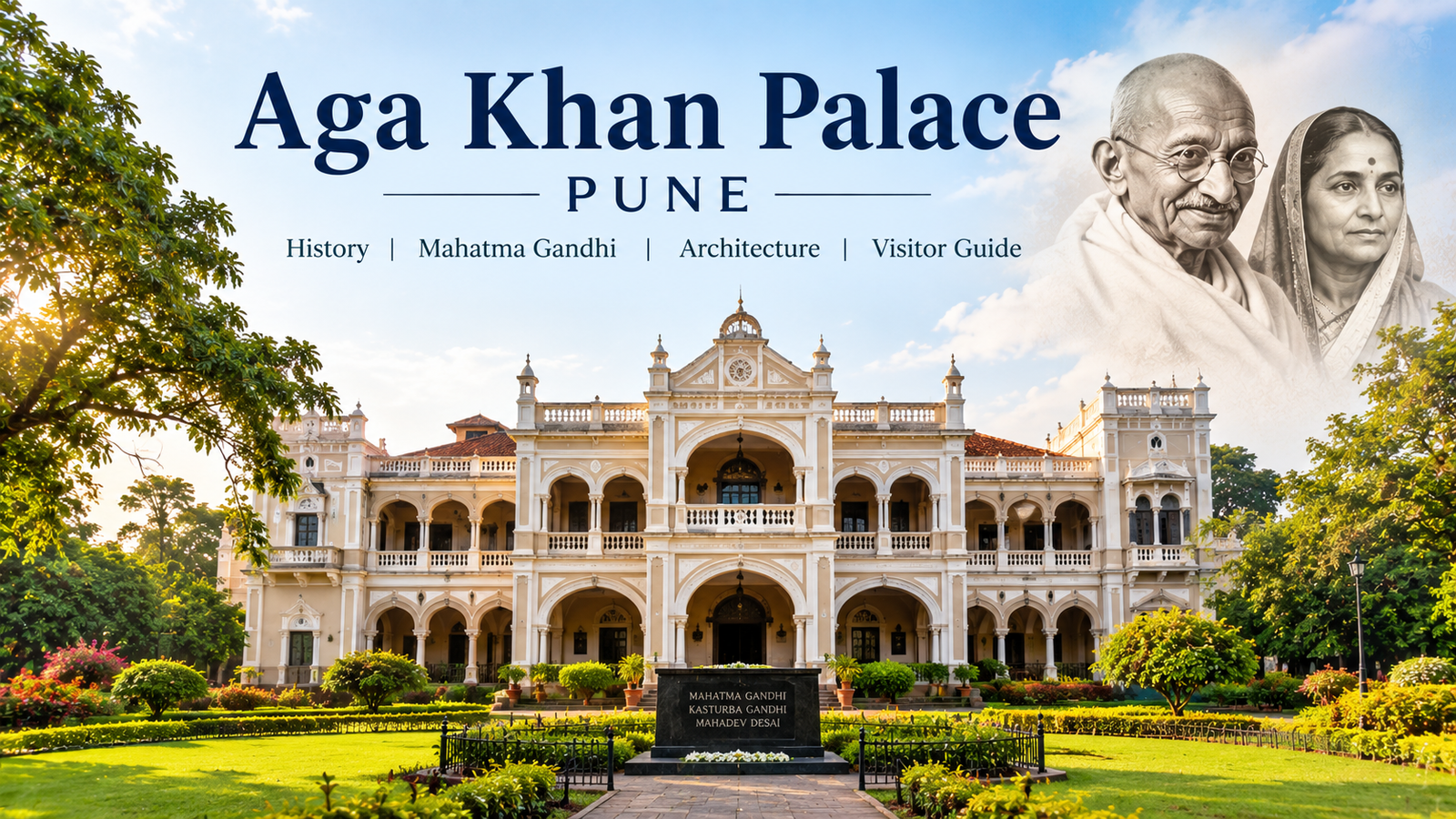
Introduction: Discover the Historic Aga Khan Palace in Pune
Pune is a city where history, culture and modern development come together. Known for its educational institutions, historic forts, temples and vibrant neighbourhoods, the city also holds an important place in India’s struggle for independence. Among its most significant historical landmarks is the magnificent Aga Khan Palace in Pune, a monument associated with Mahatma Gandhi, Kasturba Gandhi and the Indian freedom movement.
Located in the Yerawada area along Nagar Road, Aga Khan Palace is recognised for its elegant architecture, expansive gardens and deep historical significance. Although the palace was originally built in the nineteenth century, it became nationally important during the Quit India Movement of 1942, when the British colonial government detained Mahatma Gandhi and several of his associates within its premises.
The palace witnessed both personal tragedy and an important chapter in India’s fight for freedom. Gandhi’s close associate and secretary, Mahadev Desai, died there shortly after their detention began. Kasturba Gandhi, Gandhi’s wife and lifelong companion, also passed away at the palace in February 1944.
Today, the site preserves their memory through memorials, photographs, historical displays and objects associated with Gandhi’s life. Visitors can explore the palace grounds, appreciate its architecture and learn about the sacrifices made by those who participated in India’s independence movement.
Aga Khan Palace is therefore much more than a beautiful historic building. It is a place where architecture, philanthropy, political resistance and personal sacrifice meet.
In this detailed guide, we will explore the history of Aga Khan Palace, why it was built, its connection with Mahatma Gandhi, the events of the Quit India Movement, its architectural features, what visitors can see today, and practical information for planning a visit.
1. What Is Aga Khan Palace?
Aga Khan Palace is a historic monument in Pune, Maharashtra, built in 1892 by Sultan Muhammad Shah Aga Khan III.
The palace was originally constructed as a grand residence, but its historical importance grew significantly during India’s struggle against British colonial rule. In August 1942, following the launch of the Quit India Movement, the British authorities detained Mahatma Gandhi and several members of his circle at the palace.
The detainees included Kasturba Gandhi, Mahadev Desai, Sarojini Naidu, Mirabehn, Pyarelal Nair and Dr. Sushila Nayar at different stages of the confinement.
The palace became a place of intense emotional and political significance. While Gandhi and his associates were held there, Mahadev Desai died in August 1942, followed by Kasturba Gandhi in February 1944.
Their memorials remain within the palace grounds, making the site an important destination for people interested in Gandhi’s life and the Indian freedom movement.
The palace is also known for its architectural character, particularly its arches, broad corridors, spacious halls and landscaped gardens. The combination of historical importance and architectural beauty makes it one of Pune’s most recognisable heritage attractions.
Today, Aga Khan Palace houses a Gandhi memorial and museum-related displays and is associated with the work of the Gandhi National Memorial Society. The monument is also protected as a centrally protected heritage site.
2. Who Built Aga Khan Palace and Why?
Aga Khan Palace was built by Sultan Muhammad Shah Aga Khan III in 1892.
Aga Khan III was a prominent spiritual leader of the Nizari Ismaili Muslim community and an influential public figure. His interests extended to social welfare, education and political affairs.
One widely documented reason for constructing the palace was to provide employment to people affected by famine and economic hardship in the Pune region.
During periods of famine, rural communities could lose their livelihoods as crops failed and agricultural work became scarce. Large construction projects could provide wages and help families meet their basic needs.
The palace is therefore associated not only with royal architecture but also with an act of philanthropy.
A palace built during a period of hardship
The nineteenth century brought significant economic and social challenges to different parts of India. Drought, crop failures and famine placed pressure on agricultural communities, particularly those dependent on seasonal rainfall.
The construction of Aga Khan Palace is remembered as an effort to create employment during a difficult period. According to historical accounts, a large workforce participated in the project over several years.
This aspect of the palace’s history adds another dimension to its significance. It reminds visitors that historic buildings can represent more than the wealth or status of their patrons. They can also reflect social conditions and attempts to address economic hardship.
From royal residence to national memorial
When it was built, the palace was not intended to become a memorial to Gandhi. Its association with the freedom movement developed approximately fifty years later, when the British government used it as a place of detention during the Quit India Movement.
Following independence, the building gradually became recognised as an important national heritage site.
In 1969, on the occasion of the Gandhi centenary year, the palace was donated to the Gandhi Smarak Nidhi as a memorial to Gandhi and his philosophy. Its historical role was formally recognised through later heritage protection measures.
The building’s identity therefore changed over time—from a palace associated with philanthropy to a site connected with colonial detention, sacrifice and the memory of India’s freedom struggle.
3. Aga Khan Palace and the Quit India Movement of 1942
To understand the historical importance of Aga Khan Palace, it is necessary to understand the Quit India Movement.
By 1942, India had been under British colonial rule for generations. The Indian independence movement had grown through political campaigns, public protests, mass movements and negotiations.
The Second World War had placed additional pressure on the British Empire. India was drawn into the war without the agreement of elected Indian representatives, intensifying opposition to colonial rule.
Against this background, the Indian National Congress adopted the Quit India resolution in August 1942.
The call for British withdrawal
On 8 August 1942, the Indian National Congress adopted the Quit India resolution in Bombay, now Mumbai.
Mahatma Gandhi called for a decisive campaign demanding an end to British rule. His message encouraged Indians to pursue freedom through determination and mass participation.
The famous phrase associated with this movement was “Do or Die,” which reflected the seriousness of the struggle.
The British authorities responded rapidly. Gandhi and numerous Congress leaders were arrested in the early hours of 9 August 1942. The arrests were intended to prevent the movement’s leadership from organising resistance.
However, the campaign spread across different parts of India. Demonstrations, strikes and other forms of protest took place in many regions, although the movement also faced severe repression.
Why were Gandhi and his associates brought to Aga Khan Palace?
After their arrest, Gandhi and several people close to him were detained at Aga Khan Palace in Pune.
The British authorities used the palace as a place of confinement rather than holding Gandhi in an ordinary prison building.
The detention lasted from August 1942 until May 1944. During this period, Gandhi’s freedom of movement and ability to participate directly in public political activity were restricted.
Despite being confined, Gandhi continued to reflect on the independence movement, communicate through permitted channels and maintain aspects of his daily routine.
The palace became a significant location in the history of colonial repression because it held prominent figures who had become central to the demand for Indian independence.
A place of political resistance
The detention of Gandhi and his associates demonstrates how the British government attempted to weaken the Quit India Movement by removing influential leaders from public life.
Yet the movement’s wider significance did not depend solely on the physical presence of its leaders. People across India continued to express opposition to colonial rule in different ways.
Aga Khan Palace therefore represents both the restrictions imposed on India’s freedom movement and the determination of those who continued to seek independence.
4. Mahatma Gandhi’s Life at Aga Khan Palace
Mahatma Gandhi’s stay at Aga Khan Palace was one of the most difficult periods of his later life.
Gandhi was already a nationally recognised leader whose philosophy of non-violence and civil disobedience had influenced major political campaigns. His detention in 1942 occurred during a period of intense conflict between the independence movement and the colonial government.
At the palace, Gandhi lived under restrictions alongside his wife and associates.
Although the building was spacious and architecturally elegant, its use as a place of detention changed its meaning. The surroundings were no longer simply those of a grand residence; they became the setting for uncertainty, illness, bereavement and political isolation.
Gandhi’s daily routine
Gandhi’s daily life was closely connected with simplicity, discipline, prayer, reflection and work.
Even during confinement, he attempted to maintain aspects of his routine. His philosophy emphasised self-reliance and the value of simple living, including spinning cotton on a charkha.
The spinning wheel became an important symbol of the independence movement because it represented self-sufficiency, the dignity of labour and resistance to dependence on imported cloth.
Visitors to the palace can learn about these aspects of Gandhi’s life through photographs and displays associated with his time there.
The emotional cost of detention
The detention at Aga Khan Palace was not simply a political inconvenience. It placed Gandhi and his associates under considerable emotional strain.
They were separated from ordinary public life and faced uncertainty about the future of the independence movement.
The deaths of Mahadev Desai and Kasturba Gandhi made the period especially painful for Gandhi.
Their loss illustrates the human consequences of political imprisonment. Historical accounts often focus on speeches, campaigns and political decisions, but the experience of those detained also involved grief, illness and the disruption of family life.
A visit to Aga Khan Palace can help visitors understand this more personal dimension of the freedom struggle.
5. Kasturba Gandhi: The Life and Legacy of Ba
Kasturba Gandhi, affectionately known as Ba, was one of the most important figures in Mahatma Gandhi’s personal and public life.
She was Gandhi’s wife and companion for many decades. Her life intersected with major stages of his political journey, including campaigns in South Africa and India.
Although she is often remembered in relation to her husband, Kasturba had her own experiences of political participation, imprisonment and public service.
Kasturba’s role in the independence movement
Kasturba supported Gandhi through periods of political activism and personal hardship. She participated in public campaigns and experienced detention because of her involvement in the independence movement.
Her life demonstrates that the struggle for freedom was not carried out by a single leader. It depended on the contributions of many people, including women who faced social pressures, political restrictions and personal sacrifices.
Kasturba’s work and commitment are an important part of the broader history of women’s participation in India’s independence movement.
Kasturba Gandhi at Aga Khan Palace
Kasturba was detained at Aga Khan Palace along with Gandhi and several associates following the launch of the Quit India Movement.
During the period of confinement, her health deteriorated. She had experienced health problems over the years, and the conditions of detention added to the difficulties she faced.
Kasturba Gandhi died at Aga Khan Palace on 22 February 1944.
Her death was a profound personal loss for Gandhi, who had shared much of his life with her. It also made the palace a place of remembrance for people who honour her contribution to the freedom struggle.
Kasturba Gandhi’s memorial
A memorial marking Kasturba Gandhi’s resting place is located within the palace grounds.
Visitors often pause here to pay their respects and reflect on her life. The setting encourages a quieter experience than the grand exterior of the palace might initially suggest.
Kasturba’s story is a reminder that the struggle for independence involved personal sacrifice and that women played significant roles in political and social change.
6. Mahadev Desai: Gandhi’s Close Associate and Secretary
Another major figure connected with Aga Khan Palace is Mahadev Desai, Gandhi’s trusted secretary and close associate.
Desai worked closely with Gandhi for many years. He helped manage correspondence, documented political developments and supported Gandhi’s work as a public leader.
His role was particularly important because Gandhi communicated with a wide range of political figures, institutions and members of the public.
Mahadev Desai’s contribution
Desai’s work required dedication, organisational ability and a deep understanding of Gandhi’s ideas.
He helped record Gandhi’s activities and made important contributions to the documentation of the independence movement.
The role of a secretary may seem less visible than that of a political leader, but it was essential to the functioning of Gandhi’s work. Desai helped connect Gandhi’s ideas with the wider public through writing, communication and administration.
His death at the palace
Mahadev Desai died at Aga Khan Palace on 15 August 1942, only days after Gandhi and his associates were detained.
His sudden death was a devastating loss for Gandhi. Desai had been a trusted companion whose contribution extended far beyond routine administrative work.
His memorial is located within the palace grounds alongside the broader commemorative landscape associated with Gandhi and Kasturba.
Remembering Mahadev Desai helps visitors appreciate the many individuals whose dedication supported India’s independence movement, including people who worked behind the scenes rather than occupying the centre of public attention.
7. The Architecture of Aga Khan Palace
Aga Khan Palace is one of Pune’s most recognisable examples of historic palace architecture.
The building is known for its graceful arches, long corridors, spacious halls and landscaped surroundings. Its design reflects a blend of architectural influences rather than a single, narrowly defined style.
Official tourism descriptions commonly highlight its Italian-style arches and the character of its landscaped grounds.
Elegant arches and corridors
One of the palace’s most striking features is its series of arches and broad corridors.
These elements create a sense of openness and allow the building to appear spacious without relying entirely on enclosed rooms.
The corridors also provide visual continuity around the structure. As visitors move through the building, the repeated arches frame views of the gardens and surrounding grounds.
Spacious halls
The palace contains large halls that reflect its original function as a grand residence.
Their scale, arrangement and architectural character contribute to the impression of a substantial nineteenth-century building.
Today, the palace’s historic rooms and displays help connect visitors with its changing use over time, including its role as a place of detention during the independence movement.
Symmetry and open space
The building’s overall arrangement and surrounding lawns contribute to its stately appearance.
The open grounds create a visual contrast with the arches and walls of the palace. They also allow visitors to appreciate the structure from different angles.
The relationship between building and landscape is an important part of the site’s character.
The gardens and lawns
The gardens surrounding Aga Khan Palace are among its most attractive features.
The green spaces provide a peaceful environment in which visitors can pause, walk and reflect on the history of the monument.
The lawns also create opportunities for photography, although visitors should always respect site rules and avoid disturbing memorial areas.
Why the architecture matters
The architectural beauty of Aga Khan Palace is an important part of its appeal, but its significance goes beyond appearance.
The building’s changing use—from a palace built in the nineteenth century to a place of confinement in 1942 and later a national memorial—illustrates how historical structures can acquire new meanings over time.
Its architecture invites visitors in, while its history gives the visit a deeper emotional and educational dimension.
8. What Can You See Inside Aga Khan Palace Today?
A visit to Aga Khan Palace offers opportunities to explore both the building and its connection with the independence movement.
The site includes historical displays and memorial spaces that help visitors understand Gandhi’s life and the events associated with his detention.
The exact arrangement of displays and access to individual rooms may change, so visitors should follow the current instructions provided at the monument.
Photographs and historical displays
The palace contains photographs and visual material associated with Gandhi, Kasturba Gandhi and the independence movement.
These images provide historical context and help visitors connect individual people with major events.
Photographs can be particularly valuable in understanding how the freedom struggle unfolded across different periods and how public figures lived beyond their appearances in political speeches and newspapers.
Gandhi’s personal belongings
Museum descriptions of the palace refer to objects associated with Gandhi, including items connected with his simple daily routine.
These have included objects such as a spinning wheel, sandals, personal-use items and other material associated with his life.
Such objects can appear ordinary, but they help explain Gandhi’s emphasis on simplicity, self-reliance and the dignity of everyday work.
Gandhi’s room
The palace includes spaces associated with Gandhi and Kasturba during their detention.
These rooms help visitors imagine the practical circumstances of their confinement. They also provide a more intimate perspective on people whose lives are often remembered primarily through large public events.
The memorials of Kasturba Gandhi and Mahadev Desai
The memorials within the palace grounds are among the most meaningful parts of a visit.
They mark the places associated with the deaths of Kasturba Gandhi and Mahadev Desai during their detention.
Visitors often approach these areas with a sense of respect and reflection. The memorials help preserve the memory of their lives and contributions to the independence movement.
The palace grounds
The gardens and open spaces provide a quieter setting for exploring the monument.
Visitors can take time to observe the building’s architectural features, read the displays and reflect on the historical events associated with the site.
Aga Khan Palace is best experienced as both an architectural landmark and a memorial rather than simply as a place for photographs.
9. How Aga Khan Palace Became a National Memorial
After India’s independence, Aga Khan Palace continued to be associated with Gandhi’s life and the freedom movement.
Its historical significance was increasingly recognised as a place where Gandhi, Kasturba and other members of his circle had been detained during a crucial period.
The donation in 1969
In 1969, during the Gandhi centenary year, the palace was donated by Aga Khan IV to the Gandhi Smarak Nidhi as a memorial to Gandhi and his philosophy.
The donation helped establish the building’s identity as a public site dedicated to remembrance and education.
Instead of remaining only a historic palace, it became a place where people could learn about Gandhi’s life and the independence movement.
The Gandhi National Memorial Society
The Gandhi National Memorial Society has been associated with preserving the memory of Gandhi and maintaining activities connected with his philosophy.
The site has also been used for commemorative programmes and educational activities.
These efforts help connect the historical monument with contemporary discussions about non-violence, public service, self-reliance and social responsibility.
Heritage protection
Aga Khan Palace was declared a centrally protected monument of national importance in 2003.
Heritage protection is significant because historic buildings require continued attention to prevent deterioration and preserve their architectural and historical value.
Protection also reinforces the site’s importance as part of India’s national heritage.
Today, the palace continues to serve as a place of remembrance for people interested in Gandhi, the independence movement and the history of Pune.
10. The Historical Importance of Aga Khan Palace
Aga Khan Palace is important for several reasons, each offering a different way to understand its place in Indian history.
Its connection with Mahatma Gandhi
The palace is closely associated with Gandhi during the Quit India Movement. His detention there places the building within a defining period of the independence struggle.
Its memorials to Kasturba Gandhi and Mahadev Desai
The deaths of Kasturba Gandhi and Mahadev Desai during confinement give the palace a deeply personal significance.
Their memorials preserve the memory of individuals who contributed to Gandhi’s work and the broader freedom movement.
Its connection with the Quit India Movement
The events of 1942 demonstrate the British government’s efforts to suppress the independence movement by detaining its leaders.
The palace therefore serves as a reminder of the political restrictions and personal sacrifices associated with the struggle for freedom.
Its architectural value
The arches, corridors, halls and gardens make the palace a notable heritage attraction in Pune.
Its architectural character also reflects the social and cultural circumstances of the late nineteenth century.
Its role in public education
The palace provides a place where visitors can learn about Gandhi’s philosophy, India’s independence movement and the lives of those who worked alongside him.
It is particularly useful for students because it connects historical events with a physical location.
11. Aga Khan Palace and Gandhi’s Philosophy of Non-Violence
Mahatma Gandhi’s philosophy of non-violence was central to his approach to political resistance.
He believed that social and political change could be pursued through truth, disciplined action and the refusal to use violence as a primary instrument of struggle.
The Quit India Movement took place during an especially difficult period, when the demand for independence was met with widespread arrests and repression.
Gandhi’s detention at Aga Khan Palace highlights the tension between his commitment to non-violent resistance and the coercive power of the colonial state.
Satyagraha and the freedom struggle
Gandhi used the term Satyagraha to describe a form of resistance grounded in truth and moral courage.
Satyagraha was not simply passive acceptance. It involved deliberate action, public protest and a willingness to endure hardship rather than cooperate with injustice.
The philosophy influenced several campaigns against British rule, although the specific methods and circumstances varied from one movement to another.
Why this legacy remains relevant
The palace provides an opportunity to reflect on the continuing relevance of non-violence, dialogue and peaceful political participation.
Visitors may interpret Gandhi’s philosophy in different ways, but the historical site offers a setting for considering how ideas can influence movements and shape public life.
Its legacy is not limited to India’s past. Gandhi’s methods of non-violent resistance have also influenced movements for civil rights and social change in other parts of the world.
12. Best Time to Visit Aga Khan Palace, Pune
Pune generally experiences hot summers, a monsoon season and cooler winter months.
For visitors who want to explore the palace grounds comfortably, the period from October to February is often pleasant. Morning visits can be especially enjoyable because the weather is generally cooler than in the afternoon.
During the monsoon, the gardens can look particularly green, although rain may make outdoor exploration less convenient.
Summer afternoons can be hot, so consider visiting earlier in the day and carrying drinking water where permitted.
The palace may also attract more visitors on significant dates associated with Gandhi and the independence movement, including Gandhi Ja